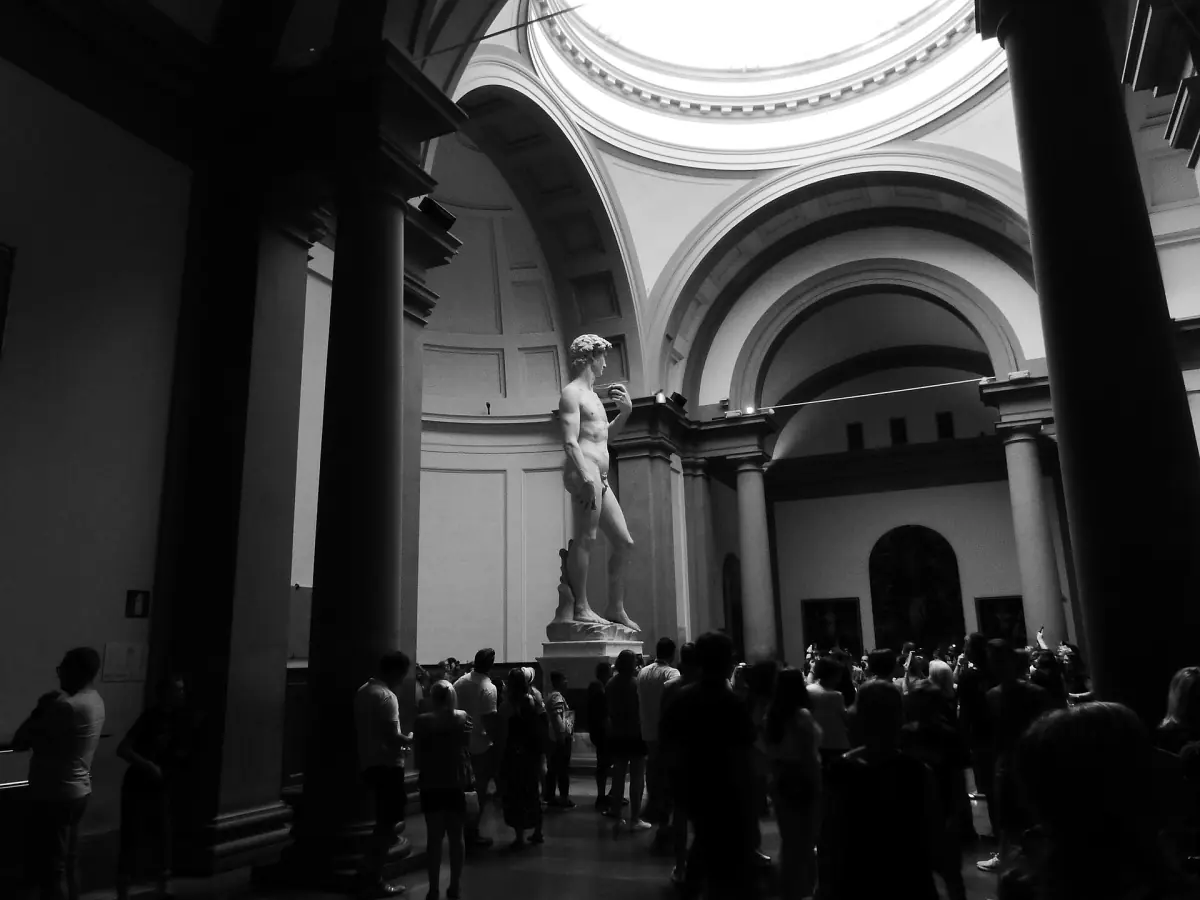
Michelangelo's Prisoners in the Accademia
On the way to the David you pass four male marble figures that look half released from the stone. They are known as the Prisoners, or the Slaves, and the museum catalogues them as the Prigioni. Michelangelo made them for the tomb project of Pope Julius II. The museum dates the group in general terms to the early 1530s.
The figures stand in the hall that leads to the Tribuna, so most visitors meet them before the David. They moved to the Accademia in 1909 from the Grotta del Buontalenti in the Boboli Garden. For the garden itself, see our Pitti Palace and Boboli guide.
What non finito looks like
Italian for unfinished. It describes what you can see, not a claim about intent.
Different stages in one stone
On each figure, some areas are smooth and others still show the rough block. You can read the stages of the work from the surface. Look at each figure from more than one angle.
No single explanation
You may hear that Michelangelo wanted to free the figure from the stone. That reading is often repeated, but it is not a documented saying of the artist. Treat any single explanation of why the figures stayed unfinished as an interpretation.
Not the Louvre slaves
The Dying Slave and the Rebellious Slave are in the Louvre. They are well-known works too, but they are not part of this group of four in Florence.
Our pick: the Prisoners on your own
Our take: the audio app lets you linger in the hall of the Prisoners before the David.
Hand-picked tours, booked through GetYourGuide. Prices are indicative starting prices in euros (as of October 2026). Tap a tour for live availability and the current price in your currency.
Accademia tours with the David and the Prisoners
Guided visits to the Accademia that walk the Prisoners hall and the Tribuna, with live prices and availability. Check what each listing includes.
The Prisoners and the David: two different jobs
The David was ordered in 1501 and unveiled in 1504. The Prisoners belong to a later project, dated to the early 1530s, so they come roughly three decades after it. The David is a finished marble, standing in its own room. The Prisoners are a group of four that you see in a row and in passing.
That makes them a good way to understand the David. In the David you see a surface worked to the end. In the Prisoners you see how the stone is cut and shaped at earlier stages. Look at the David after the Prisoners, not before, and the contrast is clearer. The route through the museum already puts them in this order.
Do not rush the hall. The Prisoners line the hall, and the Tribuna waits at the end, so the pull is always toward the David. Take a few minutes at each figure, then walk on.
Where they stand in the museum
The rooms follow one route.
Colossus room
The route starts in the Colossus room. Get your bearings here before you enter the long hall with the Prisoners.
Rooms of the Accademia →Hall of the Prisoners
The four figures stand along the long hall, leading the eye to the Tribuna at the end. The Pietà di Palestrina stands on the route between the other sculptures and the Tribuna. It is attributed to Michelangelo, so do not read it as a certain work of his hand.
Tribuna
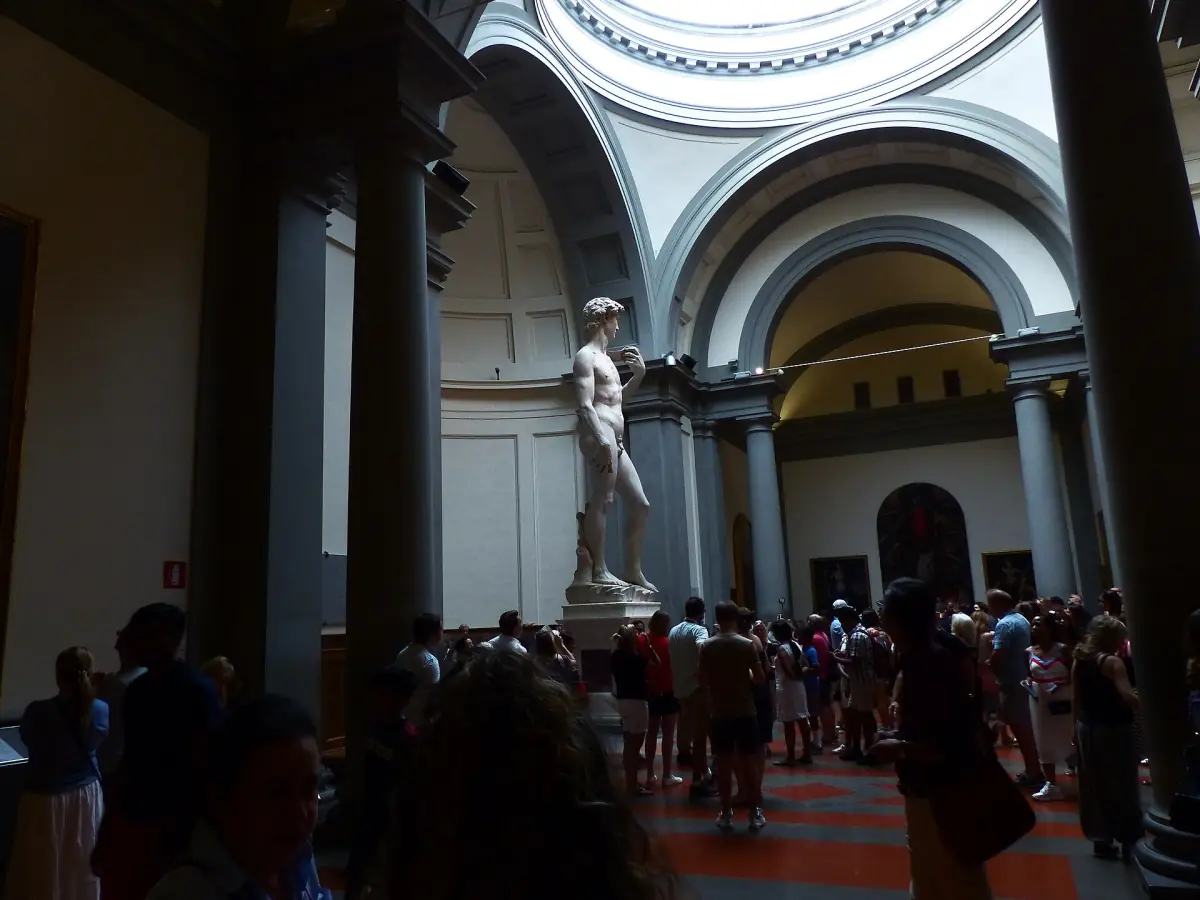
The David stands under a skylight in the room built for it. The setting, with the Prisoners behind you, is the reason many visitors take the long hall slowly.
Facts about the David →Plaster casts and paintings
After the David you reach the Gipsoteca with plaster models by Lorenzo Bartolini, then the paintings and the musical instruments.
Visiting the Prisoners: practical points
The Prisoners come with the normal Accademia ticket: €20, plus €4 for the reservation, so €24 in 2026. You can find the full price list, reductions and free days on the Accademia tickets page. The museum is open Tuesday to Sunday from 8:15 a.m. to 6:50 p.m., closed on Mondays, 1 January and 25 December. Last entry is at 6:10 p.m.
Personal photos are allowed without flash or tripod, following the staff's instructions. Do not touch the works or cross the barriers. Step to the side if you want to take your time in front of one figure. Hours and special openings are on the opening hours page.
Michelangelo's Prisoners: frequently asked questions
How many Prisoners are in the Accademia?
Four unfinished male marble figures. They were made for the tomb project of Pope Julius II and are dated by the museum to the early 1530s.
Why are the Prisoners unfinished?
There is no single documented answer. What you can see are different stages of work on each figure. Explanations of why they stayed that way are interpretations.
How did the Prisoners come to the Accademia?
They moved in 1909 from the Grotta del Buontalenti in the Boboli Garden to the Accademia, where they stand in the hall to the Tribuna.
Are the Louvre Slaves the same group?
No. The Dying Slave and the Rebellious Slave in the Louvre do not belong to the group of four in Florence.
Do I need a separate ticket to see the Prisoners?
No. They are part of the normal Accademia visit, on the way to the David. The 2026 price is €24 with the reservation.
Is this website official?
No. This is an independent guide, not run by the Accademia or any museum. Check the museum's own pages for the latest prices and hours before you go.